
I finished this quilt well over a year ago and have never gotten around to blogging about it. Isn’t that bad? I made it for my office – or should I say, my husband’s office.

It’s nice and manly right? Actually, my poor husband doesn’t have any of his own “manly” rooms in our house, as I can’t bear to give up any quilt/decorating spaces! I guess this room will have to do until we finish up a man cave in the garage.
The reason I am bringing up this quilt, is that I have wanted to do a quick tutorial on binding scallops. I have done tutorials on lots of binding techniques and I have had some requests to cover scallops as well.

I begin by MARKING my curved lines on the quilt, as shown by the yellow line in the bottom of the photo (more hints on marking the curve to come in my next post). The key here is NOT TO CUT the curve, just mark it. If you cut the curve, then you have to sew next to a stretchy, bias curved edge. NOT FUN.

Begin sewing along the curve by lining up the raw edge of the binding with the drawn line.

Sew until you reach the top inside point of the scallop. This point will be a seam allowance width above the drawn line. It is easier to show this with a photo of how it looks after it is sewn. See the red dot on the top inside point of the binding? That is where you will stop and pivot.

Now, back to that pivot point – be sure to stop with your needle DOWN, as shown, then turn the quilt so you are ready to sew along the next part of the curve.

Next, use your fingers to swing the binding over to meet the drawn line. The key here is NOT to get a tuck along the left side of the needle, but you will have one along the right side.

I usually use the point of my seam ripper to assist in getting the tuck of the fabric underneath the foot of my machine, like this.

If you have done it correctly, it will look like this: See – there is no tuck in the fabric above your sewing line, but there is a tuck to the bottom side.
Still with me?
This is how it will look after you fold the binding fabric over the sewing line. See that nice little mitered corner?

If your binding looks as shown so far, you can continue sewing along the drawn line, making the swoop along the large outside curve. The trick to this part, is to work in a little excess fabric along the bottom of the curve as shown. See the slight excess fabric ripple along the folded edge of the binding?

This part takes a little bit of practice. You need to get just the right amount of extra fabric for the curve. With really round curves, you will need to work in more excess fabric than if you have a flatter curve. I usually sew one curve first, then cut off the excess fabric so I can fold the binding to the back side and see if the curve lays flat.
Repeat until you have bound along all the curves as shown. Now you can cut along the drawn line, so you are ready to hand-stitch around the curves.

There are several little tricks that I use for to doing the hand sewing on the binding.
First, you can refer to this tutorial for my hand-stitching technique for bindings.
Secondly, you will need to take a few extra steps for making the mitered corners.
Before you get to that inside mitered corner, flip the quilt over so the front side is facing up. Pin the miter in place from the front side of the quilt as shown. (this is a different quilt and a different angle, but it is still the same technique)
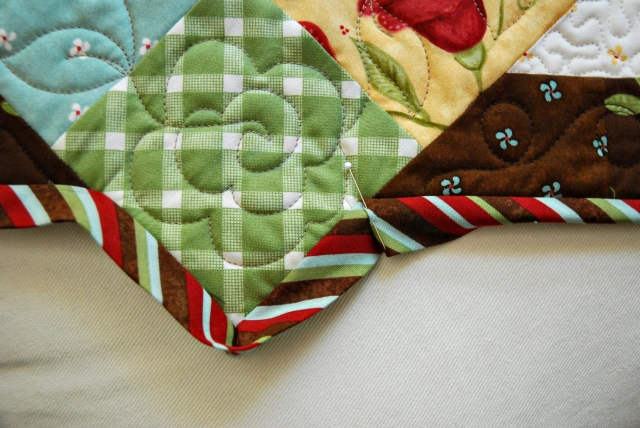
Turn the quilt over so the back side is facing up and stitch to the miter as shown. Notice how the pin is still in the front side of the miter, holding everything in place while you are stitching.

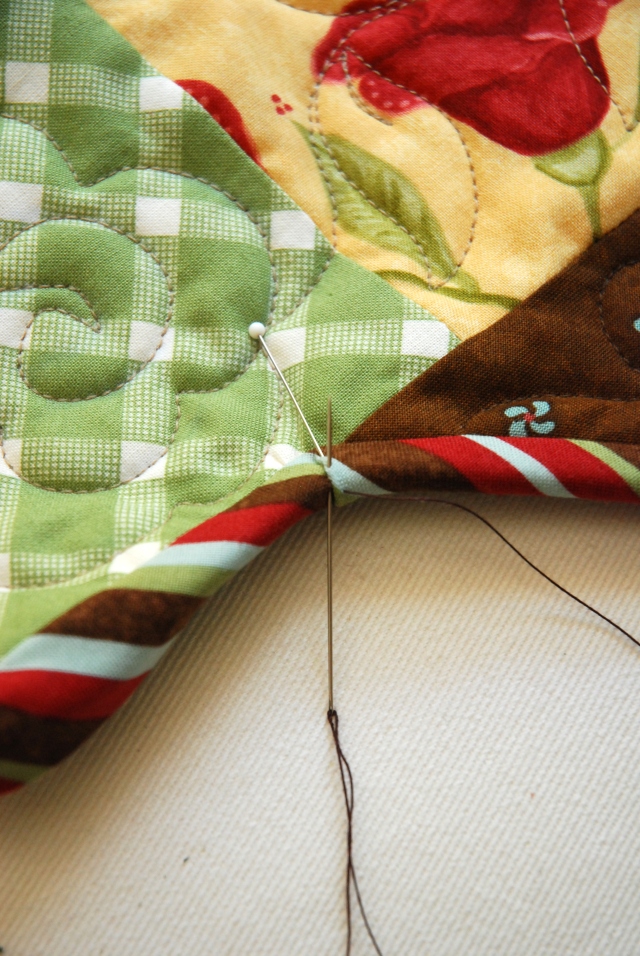
Bring the needle up inside the point as shown and do a couple of tacking stitches. If you don’t do this, the miter will just pull out after the pin is removed and you will never get it back in place!! I have learned this from personal experience ;-(

This photo shows doing the tacking stitches from the front side of the quilt. After the tacking stitches are done, continue toward the next miter.
This is how the back side looks after the hand stitching is completed. See how the curves lay nice and flat?

Next, I added a rod pocket to the back side of the quilt and hand-stitched it in place. (I cut this piece 5″ wide – Fold in half with wrong sides together, sew the long side with a 1/4″ seam and turn right-side out).

Slide a curtain rod through the pocket, hang and enjoy!

This quilt pattern was based on the Hopscotch pattern from my Fat Quarter Five book. The fabric used is Sanae. The chevron runner shown is from our On the Run book.
In my next post I am going to share some hints for figuring out the size of the curves, plus a few ways to make the process go faster. Faster is good when it comes to scallops, trust me. I have learned from experience, so I am anxious to share these tips with you also! (I just didn’t want to overwhelm you with too much info in one post).
Edit: Click here for the link to Part 2 of Binding Scallops
I am off to finish one of my boy baby quilts. I hope you have a great weekend!


 Trends and Traditions